

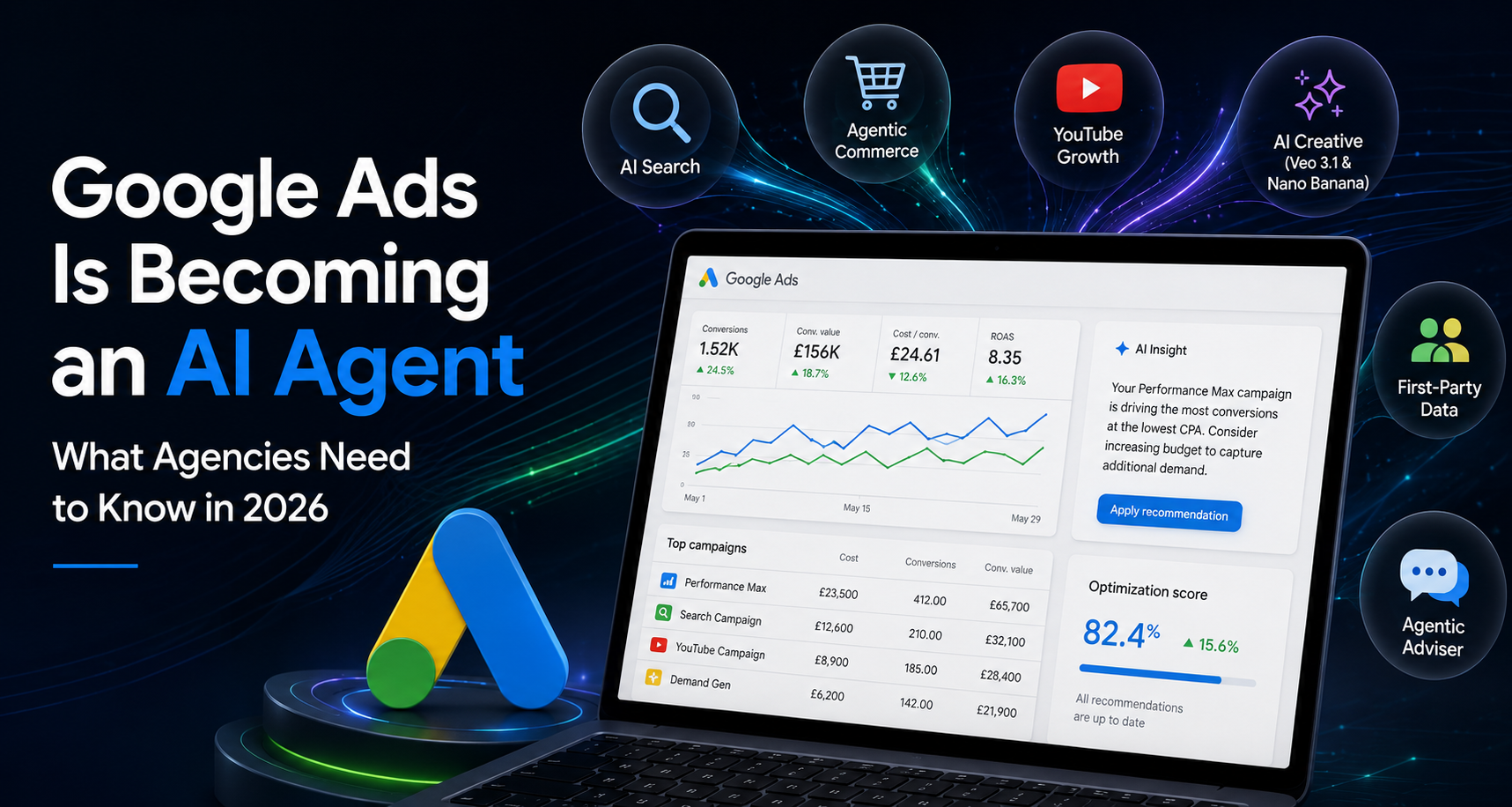
Google Marketing Live 2026 made one thing very clear: Google Ads is no longer just an advertising platform.
It is becoming an AI-led marketing system.
Search is changing. Shopping is changing. YouTube is becoming more important. Creative production is being pulled directly into Google Ads. Campaign recommendations are becoming more agentic. The customer journey is getting shorter, more conversational & harder to separate into neat little boxes like SEO, PPC, Shopping or video.
For agencies, that is exciting. It is also slightly uncomfortable.
At Lomax PPC, we have always taken a straight-talking approach to Google Ads. We are not anti-automation. Google’s machine learning has been central to the best-performing accounts for years now. But there is a big difference between using automation properly & handing over control without understanding what is happening.
That is the line agencies need to walk after Google Marketing Live 2026.
The biggest shift: AI is changing Search itself
The most important update was not one single feature. It was the continued integration of AI into the entire Search experience.
Google is now two years on from the launch of AI Overviews, & the direction of travel is clear. Search is becoming less about short keyword queries & more about longer, more specific, conversational prompts. People are no longer just searching for things like:
best running shoes
They are asking things like:
best running shoes for flat feet, road running, knee pain & training for a half marathon under £120
That matters for paid search. The old model was simpler. Users searched, clicked several ads or organic results, opened a few tabs, compared options, then eventually converted.
The new model is different. Google is trying to answer more of the question inside the search experience itself. That means the path from question to decision can become much shorter.
For advertisers, this creates a huge opportunity.
The best ads can become answers.
But only if Google understands the business properly. That means stronger landing pages, better product data, clearer service information, better creative, better conversion tracking & better first-party data. In other words, it is not enough to just run Google Ads anymore. The whole account ecosystem needs to be ready for AI-led discovery.
Long-tail search is becoming more important again
For years, Google Ads has been moving away from strict keyword control.
Close variants, broad match, Performance Max & AI-led campaign types have all pushed advertisers towards broader targeting & looser interpretation.
That has created opportunities, but also plenty of frustration.
Anyone actively managing accounts will have seen the other side of that shift:
- irrelevant search terms
- brand drift
- weak expansion
- broad matching pulling advertisers into similar auctions
- campaign types becoming harder to control
- Google pushing volume before lead or sale quality
One phrase from Google Marketing Live stood out:
“Giving you a specific edge in a very competitive landscape.”
That is an interesting line. It is also an admission of what many advertisers already feel. Google Ads is getting more competitive. Broader matching means more advertisers can be pulled into more of the same auctions. AI can help find new demand, but it can also blur the lines if it is not controlled properly.
This is why long-tail intent matters so much. The future is not just about bidding on obvious keywords. It is about helping Google understand the full context of the business, the customer, the product, the service & the value of different types of conversion. That is where experienced PPC management still matters.
Ads in AI Mode: powerful, but not something to blindly trust
Google is also bringing ads deeper into AI Mode.
This means ads can appear in more conversational, AI-assisted search experiences. In theory, that makes complete sense. If someone is asking a detailed commercial question, an ad may genuinely be useful as part of the answer.
But this also raises a serious question for agencies.
How much control will we have over how our clients are represented?
If an AI result is summarising options, answering follow-up questions & guiding users towards a decision, the quality of the underlying data becomes critical.
That includes:
- feed quality
- website content
- reviews
- pricing
- offers
- business information
- conversion data
- local availability
- landing page experience
This is especially important for agencies managing client brands through a white-label partner. Clients will not care whether a poor experience came from a campaign, an AI-generated result, a feed issue or a bad landing page. They will just see the outcome.
So yes, ads in AI Mode could be a major opportunity. But they need close monitoring.
Agentic commerce: Google wants to reduce the need for 20 open tabs
One of the bigger themes from Google Marketing Live 2026 was agentic commerce. This is Google’s move towards AI-assisted shopping journeys where users can compare, shortlist, add to cart & potentially buy across Google surfaces with much less friction.
The idea is simple. Instead of a shopper opening 20 tabs, comparing retailers manually & slowly narrowing down their options, Google’s AI can help guide that journey.
That could include:
- better Shopping ads
- AI-expanded product discovery
- direct offers
- discounts
- local availability
- hotel offers
- custom deals
- more personalised recommendations
For ecommerce brands, this could be massive. But it also means the website may no longer be the first place where the buying decision happens. Google may increasingly become the comparison layer, the recommendation layer & part of the checkout layer.
That makes product feeds even more important. Prices, images, titles, descriptions, reviews, availability, shipping, returns, promotions & brand trust signals all need to be accurate. Weak product data will become a bigger disadvantage.
For agencies, this is another reason why Performance Max cannot be treated as a black box. If Google is going to use client data across more surfaces & more AI-led buying journeys, the inputs need to be right.
Universal Cart could change ecommerce expectations
Universal Cart is another important development. The direction here is clear: Google wants shopping to become smoother across Search, YouTube, Gmail & other Google surfaces. Users may be able to build carts across retailers, compare options more easily & move closer to checkout without the old stop-start journey between websites.
For retailers, this could bring higher conversion rates if the setup is strong. But it may also reduce the amount of control brands have over the full shopping experience. That makes brand presentation even more important. If shoppers are comparing products directly within Google’s environment, the quality of product imagery, pricing, reviews, delivery details & promotional offers becomes even more visible.
This is where ecommerce agencies need to think beyond simple campaign setup.
The feed is the campaign.
The creative is the campaign.
The website is the campaign.
The tracking is the campaign.
Everything connects.
YouTube is no longer optional for serious performance marketing
Google Marketing Live 2026 also reinforced something we have been pushing clients towards for a while. Video matters. YouTube is becoming more central to performance marketing, not just brand awareness.
For ecommerce advertisers running Performance Max, this is especially important. Too many advertisers still treat video as an optional extra. They either have no proper video assets, rely on auto-generated assets, or assume video production is too expensive to justify. That argument is getting weaker.
With tools like Veo 3.1, Nano Banana & Google’s expanding creative capabilities inside Google Ads, good video assets are becoming much more accessible. That does not mean every business suddenly has a full creative studio. It does mean agencies can now help clients produce useful, on-brand video assets without needing a traditional video agency to handle everything from start to finish.
That is a big shift!
For agencies, this opens up a new level of service. A white-label PPC partner can help create, test & refresh video assets as part of the performance strategy, not as a separate creative project that takes months to organise. We have been telling clients for a couple of years that video is becoming harder to ignore. After Google Marketing Live 2026, that message becomes stronger.
If your ecommerce brand is running Performance Max without strong video assets, you are probably leaving performance on the table.
Pause ads show where attention is moving
Pause ads were another interesting part of the wider YouTube conversation. The idea is simple: when users pause video content, there is a new moment where an ad can appear without interrupting the video itself.
This might sound like a small format change, but it points to a bigger truth. Google is looking for more ways to monetise attention across YouTube without relying only on traditional pre-roll or in-stream formats.
For advertisers, the key point is not just that pause ads are coming. The key point is that YouTube inventory is evolving. If brands want to stay visible across the modern Google ecosystem, they need creative that works in more placements, more formats & more moments. Static product images alone are not enough.
Gemini, Omni, Spark & Antigravity: the wider AI stack matters
A lot of the AI announcements around Google now sit under the wider Gemini ecosystem. Gemini 3.5 Flash, Gemini Omni, Gemini Spark & Google Antigravity all point towards the same broader direction. Google is building AI systems that can understand, create, plan, code, analyse & take action across different types of input.
For marketers, we do not need to overcomplicate this. The important point is that Google owns more of the AI stack than almost anyone else. It owns the search engine, the ad platform, YouTube, Android, Chrome, Gmail, Analytics, Merchant Center, AI models & a growing set of creative tools. That gives Google a huge advantage.
It also means agencies need to be careful. When one company controls so many parts of the journey, performance can improve quickly, but transparency can also become harder. That is why human oversight still matters.
Agentic Adviser: helpful assistant or another push towards automation?
Google’s Agentic Adviser is one of the clearest examples of where Google Ads is heading. The promise is appealing.
An AI assistant inside the platform that can answer questions, diagnose issues, make recommendations, help with creative, troubleshoot policy problems & potentially carry out tasks with approval. For busy agencies, that could be genuinely useful.
There is no reason to pretend otherwise. Anyone managing multiple accounts knows how much time can be wasted digging through settings, checking policy issues, summarising performance changes or finding the cause of a sudden drop.
If Agentic Adviser helps with that, great.
But we should be realistic about the risk.
Google’s adviser is still Google’s adviser.
Its recommendations will naturally sit within Google’s ecosystem. That does not make them wrong, but it does mean agencies should not treat them as independent strategy.
An AI assistant might tell you how to increase volume.
It may not fully understand:
- the client’s margin
- the sales process
- lead quality
- internal capacity
- cash flow
- seasonality
- brand positioning
- what happens after the enquiry
That is the difference between platform advice & commercial strategy.
Used properly, Agentic Adviser could save time.
Used blindly, it could push advertisers into changes that look sensible inside Google Ads but do not make sense for the business.
First-party data is becoming the real competitive advantage
Measurement has been one of the biggest headaches in marketing over the last few years. GDPR, consent mode, privacy changes, cookie restrictions, tracking gaps & attribution issues have made reporting harder. Most advertisers now understand that platform data is not perfect. But the next phase of Google Ads makes first-party data even more important.
If AI-led campaigns are going to make better decisions, they need better signals. For lead generation, that means moving beyond basic form submissions.
At Lomax PPC, we have been pushing more clients towards proper lead qualification, CRM integrations & offline conversion tracking.
That means feeding Google better information, such as:
- which leads were qualified
- which leads became quotes
- which quotes became customers
- which services produced real revenue
- which enquiries were poor quality
- which campaigns generated pipeline, not just form fills
This is where many advertisers still fall short. A campaign that generates 100 cheap enquiries is not necessarily better than a campaign that generates 20 valuable opportunities. But Google can only learn that if the data is being passed back properly.
For agencies, this is one of the biggest opportunities. Many competitors are still optimising towards surface-level conversions. Agencies that help clients feed back qualified lead & revenue data can give Google a much better learning signal. That is not just a tracking upgrade. It is a performance advantage.
AI Max: we are still cautious
Google is clearly pushing AI Max hard. The headline numbers sound strong, including claims around increased conversions. But the quiet qualification matters:
“This works best if you can capture all demand.”
That is a big “if”.
Most advertisers are not Fortune 500 brands with unlimited budgets, perfect websites, huge conversion volumes & endless creative assets. Many advertisers are SMEs or mid-market businesses with:
- limited budgets
- uneven data
- niche services
- imperfect landing pages
- real commercial constraints
- specific locations or service areas
- sales teams with limited capacity
For those businesses, capturing all demand is not always the goal. Capturing the right demand is the goal. That is why we remain cautious about AI Max. We are not anti-AI.
We are anti-uncontrolled expansion.
For some clients, AI Max may become a useful tool. For others, it may push the account too broad, too quickly.
We would rather test carefully, monitor search terms where possible, review lead quality, control budgets & protect performance than blindly accept every new recommendation because it has an AI label attached.
Google Ads has always rewarded advertisers who test properly account by account. That has not changed.
Demand Gen is growing, but it is not always the first priority
Google is also continuing to push Demand Gen. That makes sense. Google wants advertisers using YouTube, Discover, Gmail & more visual placements to create demand, not just capture it.
For larger ecommerce brands, bigger budgets & advertisers with strong creative, Demand Gen can be a very useful expansion area. But it needs to be used in the right context. For smaller lead generation clients, the priority may still be:
- high-intent Search
- strong conversion tracking
- landing page improvements
- carefully managed Performance Max
- Shopping campaigns
- better first-party data
- clearer lead qualification
Creating demand is valuable, but only if the advertiser has the budget, creative & measurement setup to support it. This is another area where agencies need to be honest with clients. Not every Google product is right for every account at every stage.
SEO has to change too
AI Search also has big implications for SEO. If Google is answering more questions directly, generic content becomes easier to summarise & easier to ignore. The content that stands a better chance is content that is genuinely useful, specific & one of a kind.
That means:
- clear service pages
- proper product information
- genuine expertise
- useful FAQs based on real customer questions
- accessible website structure
- strong internal linking
- helpful comparison content
- clear business information
- content that answers long-tail questions properly
This matters for PPC too. Landing pages are no longer just destinations after the click. They are part of the context Google uses to understand the advertiser. A thin website makes paid media harder. A strong website gives AI-led campaigns more to work with.
The best agencies will not just switch everything on
The easy interpretation of Google Marketing Live 2026 is that AI will do more of the work.
That is true.
But it is not the full story.
AI can create assets, suggest campaigns, answer questions, expand targeting, interpret data & help users make decisions faster. But someone still needs to decide what the business is actually trying to achieve.
Someone still needs to ask:
- Is this lead valuable?
- Is this campaign growing profit or just volume?
- Is Google expanding into the right searches?
- Is the creative on-brand?
- Is the feed accurate?
- Is the data clean?
- Is the client ready for this level of automation?
- Are we measuring the outcome that actually matters?
That is where agencies still add value.
The future of Google Ads is not about manually pulling every lever. That version of PPC has been disappearing for years.
The future is about knowing which levers still matter.
What agencies should take from Google Marketing Live 2026
For agencies, the message is clear. Google Ads is becoming more powerful, more automated & more integrated across Search, YouTube, Shopping, AI, creative & measurement.
That creates major opportunities for clients. But it also increases the risk of losing control if campaigns are not managed carefully.
The agencies that win will not be the ones that simply repeat Google’s recommendations back to clients. They will be the ones that understand how to use these tools commercially.
That means stronger tracking, better first-party data, better creative, better feeds, clearer landing pages, more careful testing & a healthy level of scepticism when new automation is rolled out.
At Lomax PPC, that is exactly how we approach it.
We are excited about the future of Google Ads. AI is already helping us do things that would have been slower, more expensive or less accessible a few years ago. Video production is a perfect example. The ability to create better assets without needing a full production process is a real advantage, especially for ecommerce & Performance Max campaigns.
But we are not handing over the keys without checking where the car is going.
Google Marketing Live 2026 showed a future where ads are more intelligent, more visual, more conversational & more deeply connected to the user journey.
That future is coming quickly.
Agencies should be excited.
They should also make sure they have the right partner watching the details.