

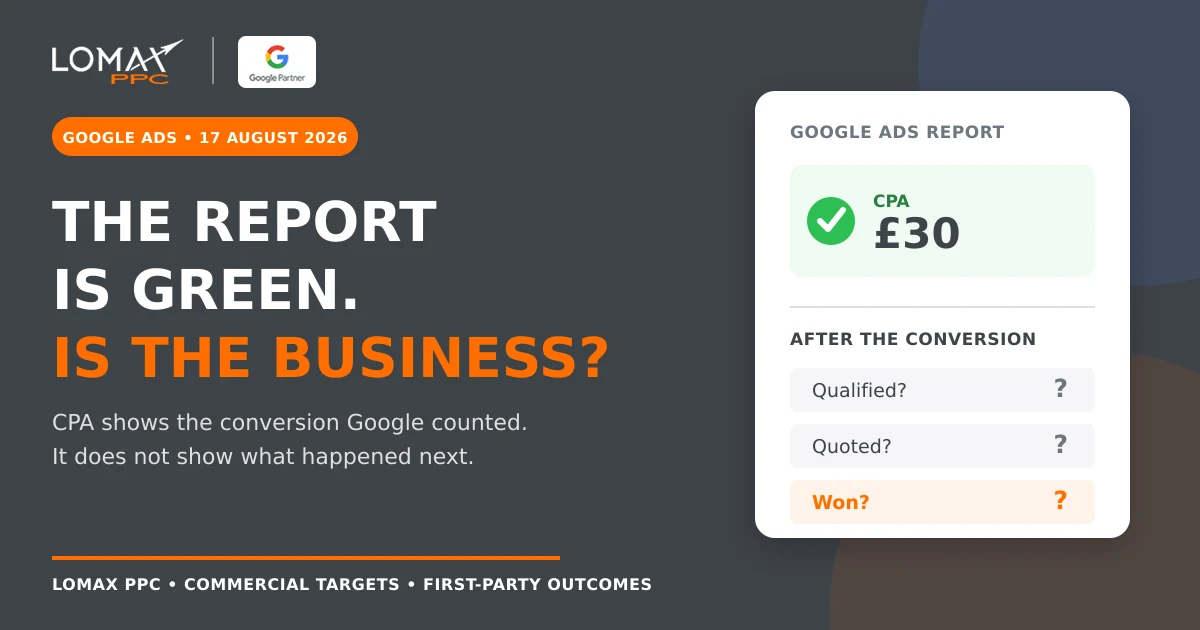
Your CPA looks good. Leads are coming in. The report is green. But what happened next?
How many of those leads were qualified? How many received a quote? How many became customers, and what were they worth? Without those answers, the CPA reported in Google Ads is useful, but it is not proof that performance is improving.
That matters more from 17 August 2026. Google says affected campaigns that are limited by budget will perform more consistently towards the Target CPA or Target ROAS entered into the account. If Google follows the target more closely, advertisers need to be much more certain that it represents the outcome the business actually wants.
The Lomax PPC view: Google can become better at hitting your target without becoming better at growing your business. That depends on whether you have given it the right target and the right conversion data.
What is actually changing on 17 August?
The update concerns affected campaigns using target-based bidding, including Target CPA and Target ROAS, while displaying a “Limited by budget” status.
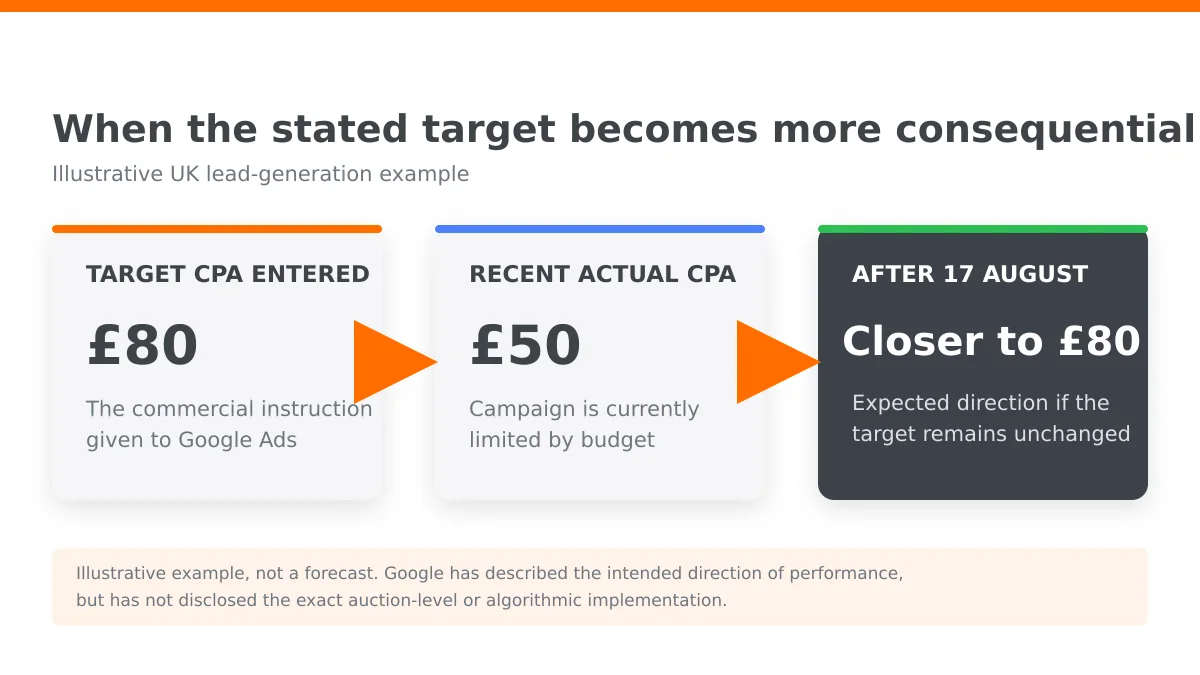
Google’s own example uses a campaign with a $10 Target CPA and a recent actual CPA of $5. After the update, if no changes are made, Google expects it to deliver closer to the stated $10 target.
In our illustrative UK example, a campaign has an £80 Target CPA but has recently achieved £50. From 17 August, performance may move closer to £80 if the target remains unchanged. Likewise, a Target ROAS campaign set to 400% but currently achieving 650% may move closer to 400%.
This is a direction of travel, not a promise of an exact result. Google has described the intended behaviour, but it has not disclosed the precise auction-level or algorithmic implementation. For Performance Max and Demand Gen, Google also warns that traffic distribution across channels may shift.
What Google is not doing: it will not automatically change campaign budgets or bidding targets. Advertisers remain responsible for reviewing and adjusting them.
The problem with calling CPA “performance”
CPA is not a bad metric. It tells you what you paid for each conversion that Google counted. The problem comes when that number is treated as the final verdict on whether advertising worked.
A £30 lead that is never qualified or quoted is not a bargain. A £60 lead that becomes a valuable, profitable customer may be. The platform CPA cannot tell you the difference unless information from further down the sales process is recorded and returned.
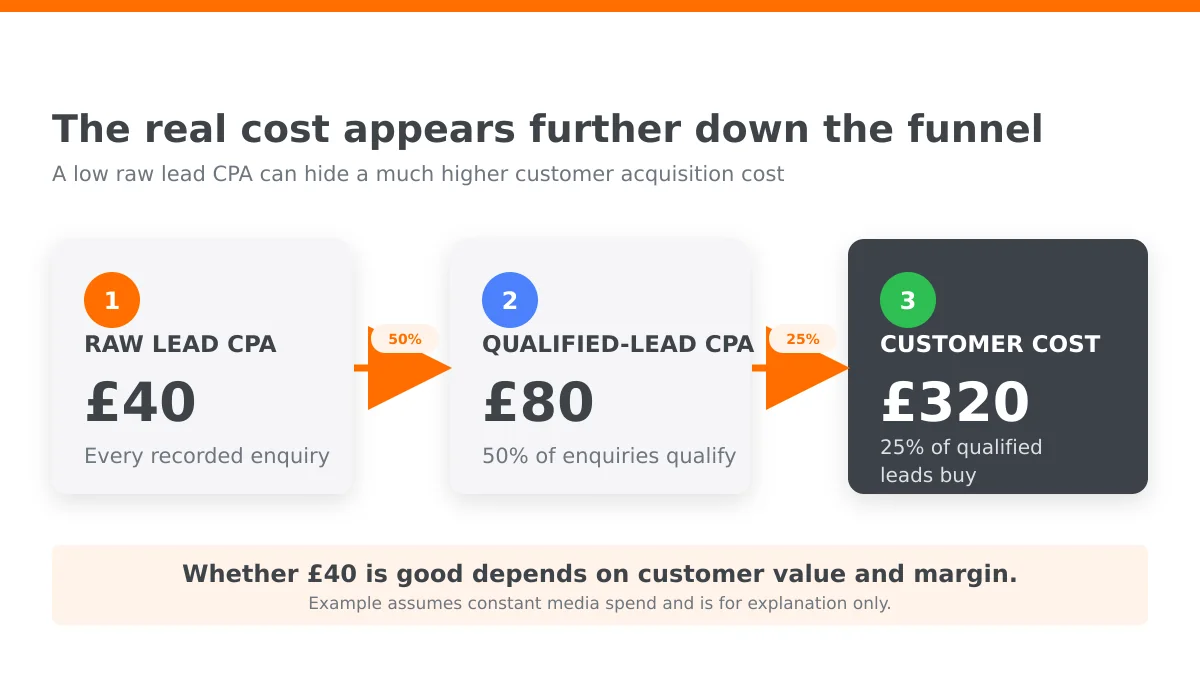
Take a campaign reporting a raw lead CPA of £40. If only half of those enquiries qualify, the qualified-lead CPA is £80. If one in four qualified leads becomes a customer, the effective advertising cost per new customer is £320.
- Raw lead CPA: cost divided by every conversion counted in Google Ads.
- Qualified-lead CPA: cost divided by enquiries the business would genuinely want more of.
- Customer acquisition cost: advertising cost divided by actual paying customers.
Whether £40, £80 or £320 is good depends on customer value, margin and the business’s growth priorities. A reported CPA without that context cannot show the commercial result.
A better target starts with commercial reality
Many bidding targets were inherited, accepted from a recommendation or based on whatever the account achieved last month. None of those routes proves the number is commercially sensible.
For a lead-generation business, the target should work backwards from:
- Average customer value and gross profit
- The percentage of enquiries that qualify, receive a quote and become customers
- Differences in value between services, products or customer types
- Sales capacity, stock, cash flow and the current appetite for growth
A business paying £35 per lead may discover that it can profitably pay £60 for the right enquiries and unlock more volume. Another may think £50 is acceptable until it learns that most enquiries never become genuine opportunities. The correct target is not automatically the lowest CPA the account has achieved.
If Google is going to take the target more seriously, advertisers need to take the data behind it more seriously too.
What better first-party data can change
Google can see that a form was submitted or a call took place. It cannot automatically know whether that enquiry was serious, spam, a job seeker, an existing customer or a high-value opportunity. That knowledge usually sits with the sales team.
The aim is to connect advertising with what happened afterwards: qualified, quoted, won or lost. A CRM, WhatConverts, Enhanced Conversions for Leads and offline conversion imports can all help create that feedback loop.
We are already seeing the value of this with clients who have acted on first-party data integration. One specialist printing client was previously generating quoted work worth around 400% of Google Ads spend. After feeding qualified-lead outcomes back into Google Ads and changing the bidding to optimise towards those qualified leads, that figure increased to approximately 600%.
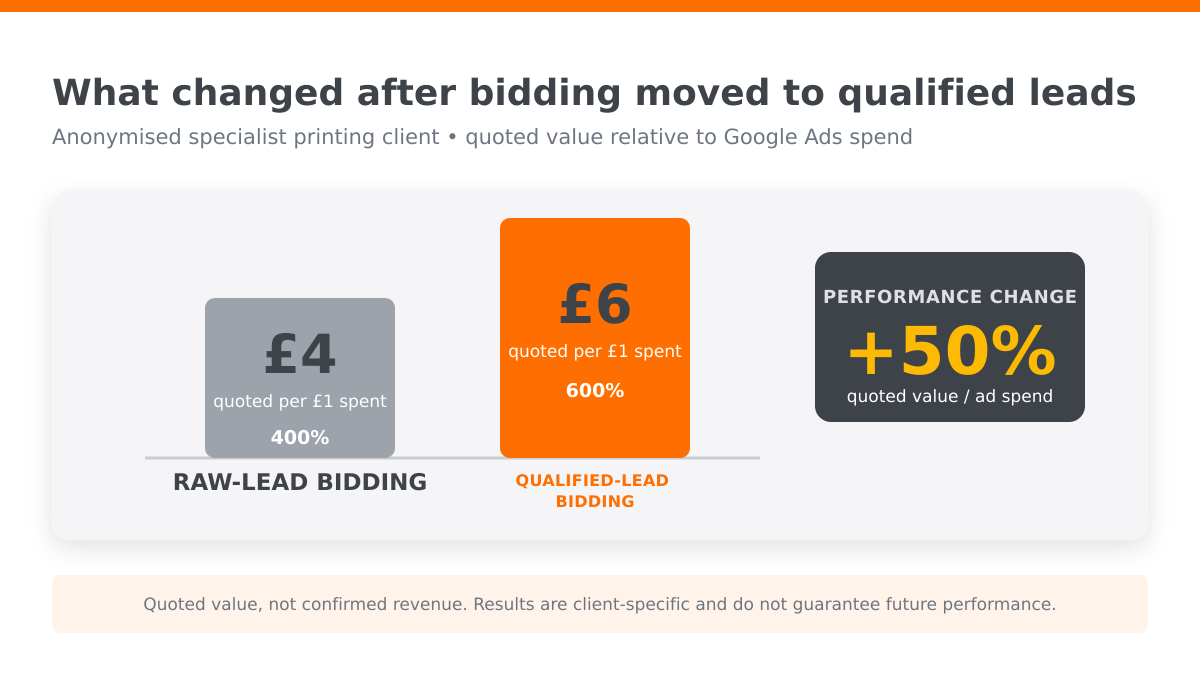
Put simply, they moved from quoting about £4 of printing work for every £1 spent on ads to around £6. That is a 50% improvement in quoted value relative to ad spend. This is quoted work, not confirmed revenue, but it was not merely a reporting improvement: the commercial value generated per pound of ad spend increased after bidding moved towards qualified leads.
Not every account has enough volume to optimise solely towards completed sales. Even so, qualification and sales data can still shape bidding targets and day-to-day decisions. Lomax PPC’s conversion tracking and PPC management work focuses on giving Google better signals while keeping commercial judgement and human oversight in the process.
The conversation agencies and clients need now
This is not about attacking CPA reporting or pretending every business has perfect sales data. It is about being honest about what the number does and does not prove.
Before changing a target or budget, agencies and clients should ask: what can the business afford to pay for a genuine customer, and what percentage of generated leads actually become one?
They should agree what constitutes a qualified lead, how outcomes will be recorded and whether the current priority is efficiency, additional volume or controlled growth. A firm budget can still be entirely sensible where cash flow, stock, service capacity or sales resources are constrained.
What should advertisers do before 17 August?
Google recommends reviewing affected campaigns before 17 August. Its Bid Target Adjustment Tool, available since 6 July 2026, compares recent performance and allows revised targets to be applied. But the CPA or ROAS achieved recently should be evidence, not the automatic answer.
Protect efficiency: tighten the CPA or ROAS target towards the result the business wants to retain, accepting that volume may fall.
Pursue profitable growth: retain a commercially acceptable target and consider more budget where demand, margins and capacity justify it.
Maintain a fixed budget: retain a hard limit while checking that the bidding target still reflects the business’s real economics.
The number Google reports is only the beginning
Google’s August update should not be reduced to a prompt to increase budgets. The real opportunity is to improve the connection between advertising data and commercial reality.
More predictable bidding could be valuable. The clients best placed to benefit will be those that know which leads are worth pursuing, feed reliable outcomes back into the account and set targets around genuine business value, not just the cheapest conversion shown in Google Ads.
Your CPA might look good. Do you know what happened after the conversion?
Lomax PPC can review your bidding, conversion tracking and commercial targets before the change takes effect.